

Is agave a cactus? This is a question that often pops up among plant enthusiasts and those interested in succulents. As a supplier of agave plants, I've encountered this query numerous times, and I'm excited to delve into the details to provide a comprehensive answer.
Botanical Classification
To understand whether agave is a cactus, we first need to look at their botanical classifications. Agaves belong to the Asparagaceae family, specifically in the Agavoideae sub - family. This family encompasses a diverse range of plants, many of which are adapted to arid and semi - arid environments.
Cacti, on the other hand, are members of the Cactaceae family. The Cactaceae family is well - known for its unique characteristics and is native primarily to the Americas. Each family has distinct evolutionary histories, which have led to the development of different physical and biological traits.
Physical Characteristics
One of the most noticeable differences between agaves and cacti lies in their physical appearance. Agave plants typically have long, thick, and fleshy leaves that grow in a rosette pattern. These leaves are often sharp - edged, with spines along the margins and sometimes at the tip. The leaves store water, allowing the plant to survive in dry conditions.
Cacti, however, are characterized by their modified stems. Instead of large, leafy structures, cacti have stems that are often thick, fleshy, and photosynthetic. Many cacti have reduced or absent leaves, and their spines are actually modified leaves. These spines serve multiple purposes, such as reducing water loss by creating a micro - climate around the plant and protecting it from herbivores.
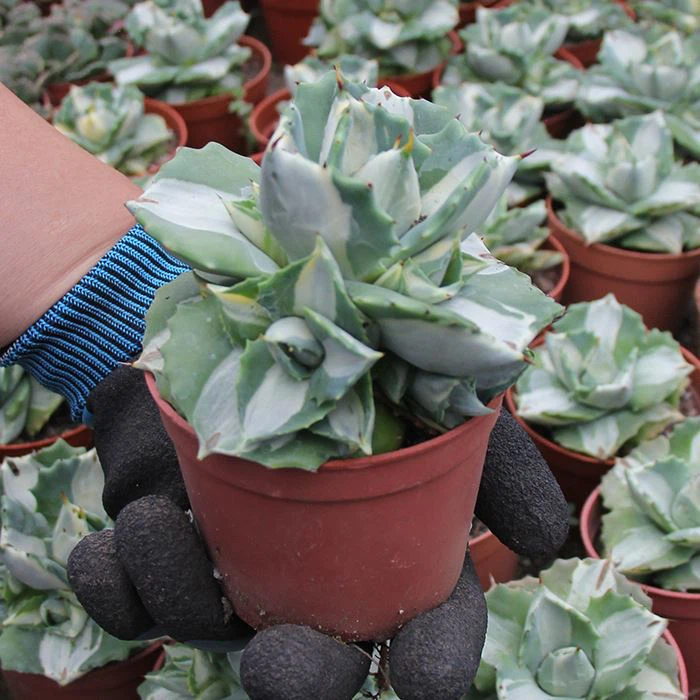
For example, the Agave Isthmensis Hoji Raijin showcases the typical agave form with its long, pointed leaves arranged in a beautiful rosette. In contrast, a barrel cactus has a round, globular stem with no obvious leaf structures.
Growth Habits
Another aspect to consider is their growth habits. Agaves are monocarpic plants, which means they flower only once in their lifetime. After flowering, the main plant usually dies, although it may produce offsets or pups before this happens. The flowering process of an agave can be quite spectacular, with a tall flower stalk emerging from the center of the rosette.
Cacti, on the other hand, can have a variety of flowering patterns. Some cacti flower annually, while others may flower less frequently depending on environmental conditions. Their flowers are often showy and come in a wide range of colors.
The Agave Potatorum Var Verschaffeltii Cv Shoji Raijin follows the typical agave growth pattern. It will grow for several years, build up energy, and then produce a large flower stalk. Once the flowering is over, the main plant will decline.
Environmental Adaptations
Both agaves and cacti are adapted to survive in harsh, arid environments, but they have different ways of doing so. Agaves have a more extensive root system that can spread out to capture water from a larger area. Their thick leaves also help in storing water for long periods.

Cacti, with their modified stems, are extremely efficient at water storage. The waxy coating on their stems reduces water loss through evaporation, and their spines help to shade the plant and reduce air movement around it, further conserving water.
The Agave Potatorum Eye Scream is well - adapted to dry conditions. Its thick leaves are a testament to its ability to store water, allowing it to survive in regions with low rainfall.
Cultural and Economic Significance
Agaves have a long history of cultural and economic importance. They have been used by indigenous people for centuries for food, fiber, and medicine. The sap of some agave species can be fermented to make alcoholic beverages such as tequila and mezcal.
Cacti also have cultural significance in some regions, especially in the Americas. They are often used in traditional medicine and are popular as ornamental plants.
As an agave plant supplier, I understand the value of these plants. Whether you're a landscaper looking to add a touch of the desert to a project or a collector interested in rare and unique agave species, I can provide you with high - quality plants.
Conclusion
In conclusion, agave is not a cactus. Although they share some similarities, such as their ability to thrive in arid environments, they belong to different plant families and have distinct physical characteristics, growth habits, and adaptations.
If you're interested in adding agave plants to your collection or project, I invite you to reach out for a procurement discussion. I'm always happy to share my knowledge and provide you with the best agave plants available.
References
- Hickman, J. C. (Ed.). (1993). The Jepson Manual: Higher Plants of California. University of California Press.
- Nobel, P. S. (1994). Physiological Ecology of Cacti. Cambridge University Press.
- Trelease, W. (1911). The Agaves of North America. Carnegie Institution of Washington.