

Hey there, plant enthusiasts! As a long - time agave plant supplier, I've spent countless hours surrounded by these amazing succulents. One of the most common questions I get from customers, whether they're seasoned gardeners or just starting out, is "How do you identify an agave plant?" Well, buckle up, because I'm about to share all the tips and tricks I've picked up over the years to help you tell an agave apart from other plants.
Physical Appearance
First off, let's talk about the general look of an agave. Agaves are succulents, which means they've got that thick, fleshy tissue that helps them store water in arid conditions. Most agaves have a rosette shape, kind of like a flower that's been flattened out. The leaves grow from a central point at the base, spreading outwards in a circular pattern.
Leaves
The leaves are the key to identifying an agave. They're usually thick and rigid, with a waxy or leathery texture. This helps prevent water loss in their natural, dry habitats. The color of the leaves can vary widely, from a bluish - gray to a deep green, and sometimes even with hints of red or purple.
Another important feature of agave leaves is the margin, or the edge of the leaf. Many agaves have sharp spines along the margins. These spines can be small and evenly spaced or large and menacing. At the tip of each leaf, there's often a single, large terminal spine. This spine is usually longer and sturdier than the marginal spines. For example, the Agave Potatorum Var Verschaffeltii 'Medio - picta' has beautiful, variegated leaves with sharp spines along the edges, making it quite distinct.
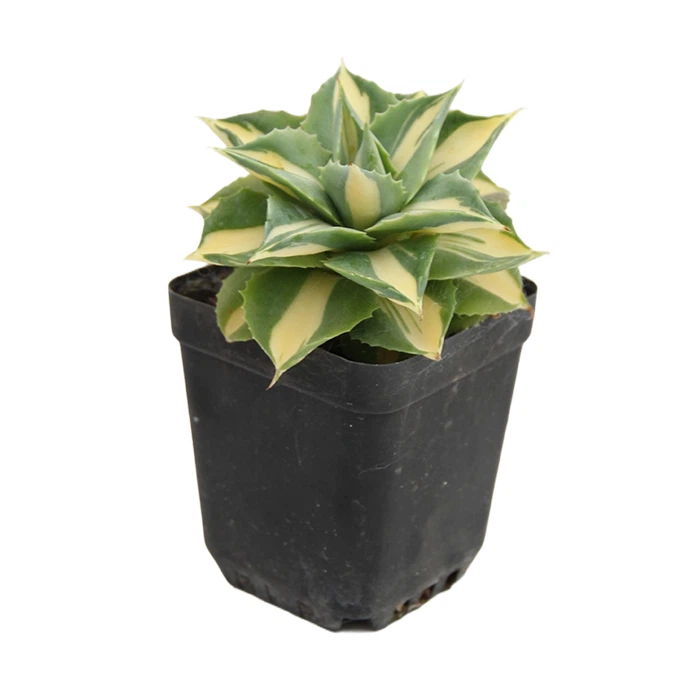

The shape of the leaves can also give you clues. Some agaves have long, narrow leaves that curve gracefully outwards, while others have short, wide leaves that are almost triangular. The Agave 'Burnt Burgundy' has leaves that are more triangular in shape and a unique burgundy color, which really stands out.
Size
Agaves come in all sizes, from tiny little guys that you can fit in the palm of your hand to huge specimens that can reach several feet in diameter. Smaller agaves, like the Agave parviflora, are great for container gardening or rock gardens. On the other hand, larger agaves, such as the Agave americana, can be the centerpiece of a large landscape.
Growth Habit
Agaves have a unique growth habit that can help with identification. Most agaves are monocarpic, which means they flower only once in their lifetime. After flowering, the main plant usually dies, but it often produces offsets or "pups" around the base before it goes. These pups can be separated and grown into new plants.
The flowering process of an agave is quite spectacular. When it's time to flower, a tall stalk shoots up from the center of the rosette. This stalk can reach incredible heights, sometimes taller than the plant itself. The flowers are usually tubular in shape and can be white, yellow, or greenish - yellow. However, since agaves flower only once and it can take many years for them to reach maturity, it's not always easy to identify them based on their flowers.
Habitat and Range
Knowing where an agave is from can also be a big help in identification. Agaves are native to the Americas, mainly in the southwestern United States and Mexico. Different species have adapted to different habitats within this range.
Some agaves grow in deserts, where they have to deal with extreme heat and very little water. These desert - dwelling agaves usually have thick, spiny leaves to protect them from the harsh environment. Other agaves are found in more mountainous regions, where the climate is cooler and there's more moisture. These agaves might have softer leaves and a different growth pattern.
Root System
The root system of an agave is another characteristic that can be used for identification. Agaves have a fibrous root system that spreads out horizontally just below the surface of the soil. This allows them to quickly absorb any water that falls on the ground. The roots are usually thick and strong, helping the plant to anchor itself in the often - rocky or sandy soil of its natural habitat.
Comparing Similar Plants
There are some other plants that look similar to agaves, such as yuccas and aloes. Yuccas also have long, spiny leaves in a rosette shape, but they usually have more flexible leaves and their flowers are different. Yucca flowers are bell - shaped and hang down from the flower stalk, while agave flowers are tubular and stand upright.
Aloes, on the other hand, are also succulents, but their leaves are usually more flexible and have a gel - like substance inside. The spines on aloe leaves are smaller and softer compared to those of an agave.
Common Species Identification
Let's take a closer look at some common agave species and how to identify them:
Agave victoriae - reginae
This is a small, slow - growing agave that's very popular among collectors. It has short, wide leaves that form a tight rosette. The leaves are dark green with white markings along the margins, which look like they've been painted on. There are no spines along the margins, only a small terminal spine.
Agave attenuata
The Agave attenuata is known as the "foxtail agave" because of its long, arching flower stalk. It has soft, spineless leaves that are a light green color. This agave is more tolerant of shade and moisture compared to other species, making it a great choice for gardens in less arid regions.
Agave Potatorum Var Verschaffeltii Cv Shoji Raijin
This is a variegated form of Agave potatorum. It has beautiful, striped leaves with a combination of green and white colors. The spines along the margins are small but sharp, and the terminal spine is quite prominent.
Conclusion
Identifying an agave plant can be a fun and rewarding challenge. By looking at the physical appearance, growth habit, habitat, and comparing it to similar plants, you can become an expert at telling different agave species apart.
If you're interested in adding some agaves to your collection, whether it's for a garden or a container, I'm here to help. As an agave plant supplier, I've got a wide variety of species to choose from, all carefully grown and ready to be shipped to your doorstep. Don't hesitate to reach out if you have any questions or want to discuss your specific needs. Let's get those agaves growing in your space!
References
- "Agaves, Yuccas, and Related Plants" by Greg Starr
- "The Genus Agave" by Howard Scott Gentry