

Measurement of sugar content in agave plants is a crucial aspect, especially for those of us in the agave plant supply business. As an agave plant supplier, understanding the sugar content is not only important for assessing the quality of our products but also for meeting the diverse needs of our customers, whether they are looking for agave plants for syrup production, tequila - making, or simply as ornamental plants. In this blog, I'll share some of the key methods used to measure the sugar content in agave plants.
Destructive Sampling Methods
The most direct way to measure sugar content in agave plants is through destructive sampling. This method involves harvesting a part of the plant, usually the core or the pina of the agave, which is the main part where sugars accumulate.
One of the commonly used techniques within destructive sampling is refractometry. Refractometers measure the refractive index of a liquid sample. In the case of agave, the sap extracted from the pina is placed on the prism of the refractometer. The refractive index of the sap is then related to the sugar concentration. A high refractive index indicates a high sugar content. The principle behind this is that the more sugar is dissolved in the sap, the more it will bend light passing through it.
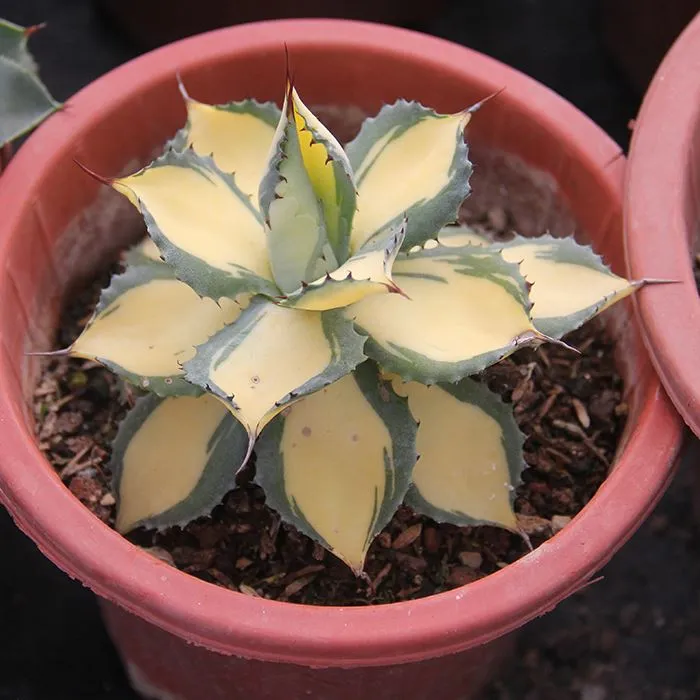
For example, if we take a sample from an Agave Titanota White Whale, we first need to extract the sap. This can be done by crushing and pressing the sample to obtain a liquid. Once the sap is extracted, a few drops are placed on the refractometer. After closing the prism cover, we look through the eyepiece to read the refractive index value, which can then be converted into a Brix scale reading. The Brix scale is a unit of measurement that represents the percentage of dissolved sugars in a solution. Most commercial agave plantations use this scale to assess the ripeness and sugar content of their agaves.
Another destructive method is high - performance liquid chromatography (HPLC). HPLC is a more advanced and precise technique. It separates the different components of the agave sap, including various sugars such as fructose, glucose, and sucrose. The sap is injected into a column filled with a specific stationary phase, and a mobile phase is used to carry the sample through the column. Different sugars interact differently with the stationary phase and will elute at different times. This allows for the identification and quantification of each type of sugar in the sample.
However, HPLC requires expensive equipment and trained personnel to operate. It is more commonly used in research settings or larger - scale agave processing facilities. For a small - to medium - sized agave plant supplier like us, we may use this method occasionally for quality control purposes or to test new agave varieties, such as Agave Titanota Cv. Black And Blue to understand its sugar profile.

Non - Destructive Sampling Methods
Non - destructive sampling methods are becoming increasingly important as they allow us to assess the sugar content without harming the plant. This is particularly useful for live plants that are being grown for ornamental purposes or for future harvests.
Near - infrared spectroscopy (NIRS) is a promising non - destructive technique. NIRS works by shining near - infrared light on the agave plant tissue. Different chemical bonds in the sugars absorb specific wavelengths of light. By analyzing the spectrum of the reflected light, we can determine the sugar content in the plant. This method has several advantages. It is fast, non - invasive, and can be used in the field.
To use NIRS on agave plants, a handheld NIRS device is placed against the plant, usually on the leaves. The device emits the near - infrared light and measures the reflected light. The data collected is then analyzed using software. The software has a calibration model that correlates the spectral data with the sugar content. However, the accuracy of NIRS can be affected by factors such as the thickness of the plant tissue, the presence of other substances in the tissue, and environmental conditions.
Ultrasound technology can also be used for non - destructive measurement of sugar content. Ultrasound waves are passed through the agave plant tissue. The velocity of the ultrasound waves changes depending on the density and composition of the tissue. Since sugar content affects the density of the plant sap, the velocity of the ultrasound waves can be related to the sugar concentration. This method is still in the experimental stage for agave plants, but it shows potential for being a practical non - destructive option in the future.
Factors Affecting Sugar Content in Agave Plants
Several factors can influence the sugar content in agave plants. The age of the plant is a significant factor. Generally, older agave plants have a higher sugar content. For example, agave plants used for tequila production are typically harvested when they are around 8 - 12 years old, as this is when the sugar content in the pina is at an optimal level.
Environmental conditions also play a crucial role. Agave plants thrive in arid and semi - arid regions with plenty of sunlight. Plants grown in areas with more sunlight and proper water management tend to have higher sugar contents. Temperature fluctuations can also affect sugar accumulation. During cooler nights, the agave plant's metabolic processes slow down, which can lead to more efficient sugar storage.
Soil quality is another important factor. Well - drained, nutrient - rich soils are ideal for agave growth. Soils with a balanced pH level and appropriate amounts of minerals, such as nitrogen, phosphorus, and potassium, can support healthy plant development and sugar production.
Importance of Measuring Sugar Content for Our Business
As an agave plant supplier, accurately measuring sugar content has several benefits for our business. For customers who are interested in using agave for syrup or tequila production, sugar content is a key determinant of the quality of the final product. By providing information on the sugar content of our plants, we can give our customers more confidence in their purchases.
For ornamental plant buyers, understanding the sugar content can also be beneficial. Higher sugar content can sometimes indicate a healthier plant. We can use this information in our marketing to highlight the quality of our Agave Potatorum'Rum Runner' and other agave varieties.
Moreover, measuring sugar content helps us in the management of our plantations. It allows us to determine the optimal time for harvest, which can maximize the yield and quality of our products. By using different measurement methods, we can ensure that we are providing the best possible agave plants to our customers.
If you are interested in purchasing high - quality agave plants with known sugar content, we invite you to contact us for procurement discussions. We are committed to providing you with detailed information about our products and finding the best agave solutions to meet your specific needs.
References
- Bartholomew, D. P., & Koike, S. T. (Eds.). (2007). Compendium of agave, yucca, and related plant diseases. American Phytopathological Society.
- Nobel, P. S. (1988). Environmental Biology of Agaves and Cacti. Cambridge University Press.
- Turner, L. B., & Henry, R. J. (Eds.). (2010). Near - infrared spectroscopy in plant science. CABI.