


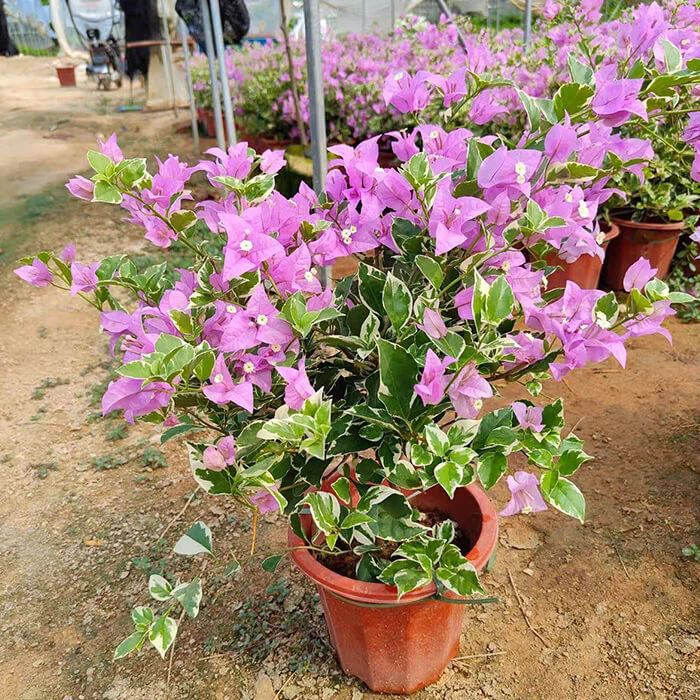
Bougainvillea 'Mrs Eva Variegata Purple' Plant Features
Morphological characteristics: Bougainvillea 'Mrs Eva Variegata Purple' is a vine-like shrub with axillary thorns. The leaves are elliptical or ovate, with a rounded base and petiolate. The inflorescence is axillary or terminal, with elliptical ovate bracts, purple; the perianth tube is narrowly tubular, densely covered with soft hairs, with 5-6 lobes at the top, and the lobes are open; the fruit is 1-1.5 cm long and densely covered with hairs.
Growth habits: It likes warm, humid climates and sunny environments. It is not cold-resistant, resistant to barrenness, drought, salt and alkali, and resistant to pruning.
Flower color: The color of the bracts gradually turns purple and becomes darker and darker, the perianth tube also turns purple, the star flowers are yellow-green, and yellow stamens can be seen in the middle of the flowers.
Bougainvillea 'Mrs Eva Variegata Purple' Special Care or Planting instructions
- Light
Light requirements: Bougainvillea 'Mrs Eva Variegata Purple' needs full sun, at least 6-8 hours of direct sunlight per day, which can promote more flowering.
Best location: It should be planted in a place that receives direct sunlight every day, such as a south-facing balcony or courtyard.
- Water
Watering frequency: During the growing season (spring and summer), water twice a week, and you may need to water twice a day in summer. Reduce watering frequency in winter.
Avoid standing water: Make sure the soil is well drained to avoid standing water, which can cause root rot. Before watering, check that the top 2-3 cm of the soil is dry.
- Soil
Soil type: Bougainvillea 'Mrs Eva Variegata Purple' prefers fertile, well-drained soil with a pH between 5.5-6.0.
Soil amendment: You can add some sand, peat moss, perlite or vermiculite to the soil to improve drainage.
- Temperature
Suitable temperature: Bougainvillea 'Mrs Eva Variegata Purple' prefers warm climates and is not cold-tolerant. In cold areas, the plant needs to be moved indoors or protected with mulch in winter.
Growing temperature: Night temperature should not drop below 16°C and daytime temperature should not exceed 38°C.
- Fertilization
Frequency of fertilization: Apply a balanced fertilizer every 4-6 weeks during the growing season (spring and summer).
Fertilizer selection: You can use a balanced slow-release fertilizer of 10-26-26, or you can use a high-phosphorus fertilizer and flower fertilizer to promote flowering.
Organic selection: If you prefer organic fertilizers, compost is the best choice. Banana peel fertilizer also helps flowering.
- Pruning
Pruning time: Prune in late winter or early spring before new branches grow.
Pruning method: Use sharp, clean scissors and cut branches at the leaf axils to promote new branch growth. Be careful when pruning because Bougainvillea has thorns.
- Support
Support needs: Bougainvillea 'Mrs Eva Variegata Purple' can grow as a shrub or vine, sometimes requiring support. If planted against a wall or fence, a climbing frame can be used to provide support.
Support methods: Lightly tie the branches to the climbing frame or support structure with gardening ties or soft cloth, avoiding tying too tightly to avoid damaging the branches.
- Pest and disease control
Common pests and diseases: Common pests include aphids and spider mites. Pests can be treated with insect soap or neem oil. Check the plant regularly for signs of pests.
No flower problems: If the plant is not blooming, it may be due to insufficient light or overwatering. Check the watering schedule and light exposure.
Yellow leaf problems: Yellow leaves can be a sign of overwatering or poor drainage. Make sure the soil is well drained and the plant is not soaked in water for long periods of time.
Hot Tags: bougainvillea 'mrs eva variegata purple', China bougainvillea 'mrs eva variegata purple', Bougainvillea Alexandra , bougainvillea plant


